On Friday, October 16, 2026, IRCC announced the first of its changes to the Express Entry system. Starting November 3, the Comprehensive Ranking System (CRS) adds a new labour market integration factor with extra points for high-wage occupations. Here’s what has been announced, what remains unclear, and how to think about your own profile.
What Did IRCC Announce on October 16?
IRCC amended the CRS by introducing a new labour market integration factor, which has two parts:
- High-wage occupation points for Canadian work experience in a listed occupation
- Job offer points for candidates who have a job offer in a high-wage occupation but cannot claim Canadian work experience points
Canadian work experience now sits within this labour market integration factor. The regular Canadian work experience points still exist. The high-wage points are an addition on top of them, and the job offer points are a separate category.
What Is the High-Wage Occupation List?
IRCC compared the median wage of workers in each occupation across Canada with the median wage of the overall Canadian workforce. It then created a list with three categories:
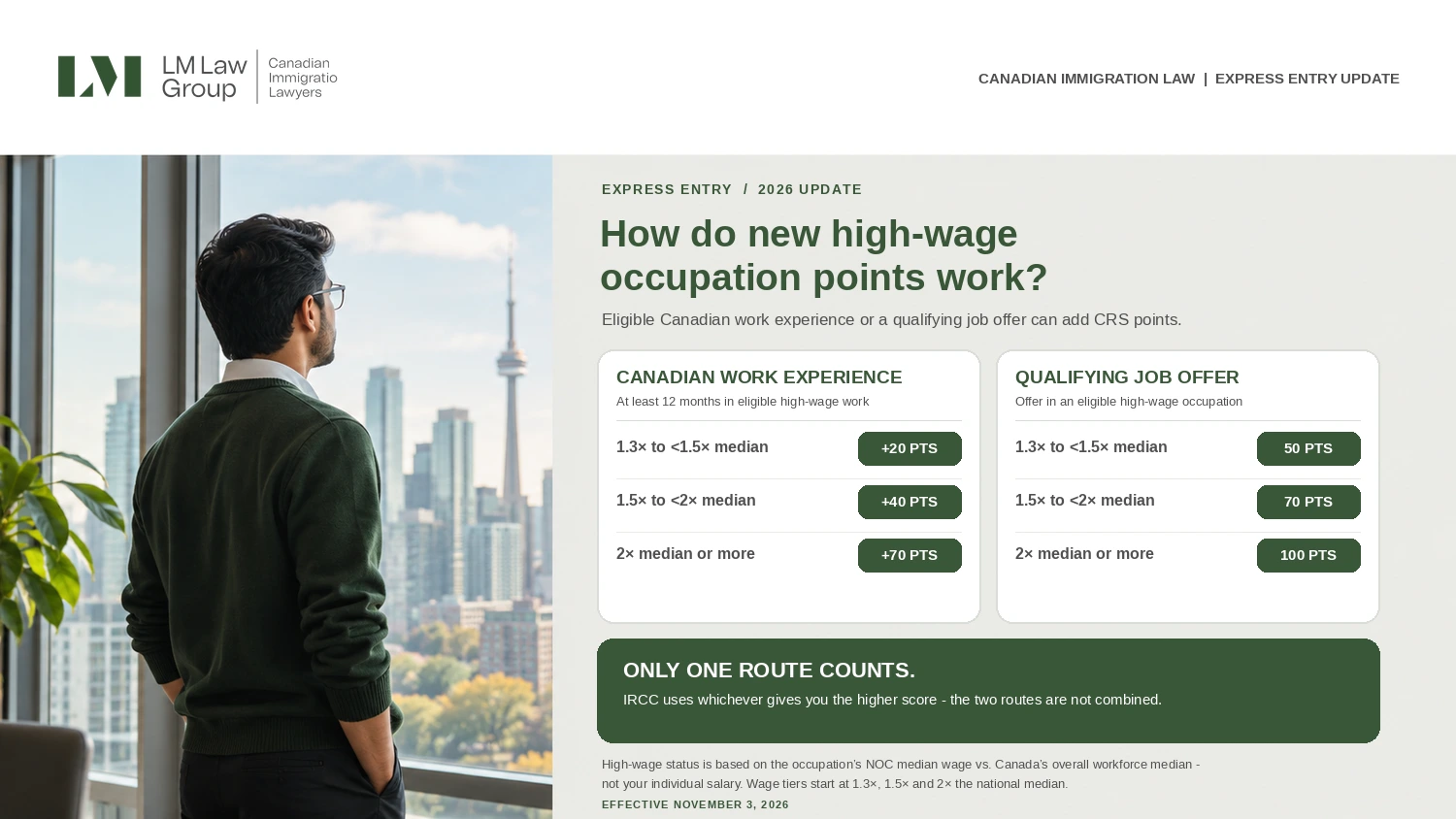
- Occupations with a median wage 1.3 times higher
- Occupations with a median wage 1.5 times higher
- Occupations with a median wage 2 times higher
Each occupation on the list is shown with its NOC code, so you can look up your occupation directly.
Importantly, this is about the median wage of the occupation, not your own salary. It doesn’t matter what you personally earn. What matters is which occupation, and which category of the list, your work experience or job offer falls under.
How Do High-Wage Points Work With Canadian Work Experience?
You still receive the regular CRS points for your Canadian work experience. In addition, if you have one year of eligible Canadian work experience in a listed high-wage occupation, you receive additional points. The number of additional points depends on which category of the list your occupation falls under.
Two examples from the webinar, both for a single applicant:
- One year of Canadian work experience in an occupation in the 1.5 times category: 40 regular points plus 40 additional points.
- One year of Canadian work experience as a physician, which is in the 2 times category: 40 regular points plus 70 additional points, for a total of 110.
IRCC has confirmed that the definition of work experience is the same as under the current Express Entry system. That means the work must still meet the existing requirements. It can be gained in multiple high-wage occupations and combined to reach one year, it does not need to be continuous, and it can be full-time, part-time, or a combination, as long as it adds up to one year. Self-employment work experience would not count (unless it‘s for physicians). The work must be for a Canadian business and performed in Canada.
How Do Job Offer Points Work?
The second part of the factor is for people who can’t claim Canadian work experience points but do have a job offer in a high-wage occupation. As with work experience, what counts is the occupation’s median wage, not the salary on the offer.
Under the example discussed in the webinar, a physician with a job offer would receive 100 points.
Two related changes to LMIAs were also announced:
- An LMIA is not required to get these job offer points.
- An LMIA is no longer required for arranged employment under the Federal Skilled Worker Program or for eligibility under the Federal Skilled Trades Program. A job offer is enough. Some people who don’t qualify under the Canadian Experience Class may therefore still be able to enter the pool through the Federal Skilled Trades Program.
These changes apply to Express Entry only. They do not affect the requirement for an LMIA for a work permit, which is a separate matter.
Can You Claim Both Job Offer Points and Work Experience Points?
IRCC has said you cannot have both. The system will calculate both sets of points and apply whichever is higher to your profile.
For example, a physician with one year of Canadian work experience and a job offer as a physician could claim either 110 points for the work experience or 100 points for the job offer. They would take the higher of the two, which is the 110 points. In general, if you have a year of Canadian work experience, the work experience points will usually be higher than the job offer points.
How Will Officers Assess Job Offers?
This is the area that is the most uncertain. The information on IRCC’s website about job offers is currently quite loose. For example, nothing published so far says the offered wage must meet the median wage, and IRCC has said officers will examine the viability of the job and whether it is genuine.
What that means in practice is not yet clear. The assessment Service Canada officers used to carry out for LMIAs, such as whether the employer runs an active business, whether a real offer has been made, and whether the employer can fulfil its terms, now moves to IRCC officers. As a result, we predict the following:
- Longer processing times, particularly for job offers
- More procedural fairness letters (PFLs), particularly for candidates who aren’t yet working in the position, such as those outside Canada or moving into a promotion
- Closer scrutiny of whether the employer can actually hire you, why they would, and whether you’re qualified
There was a history of fraud with LMIAs, and we would caution you not to pay anyone for a job offer which could be found as misrepresentation and carry with it a penalty of 5-year bar from Canada.
One practical point raised in the webinar is that the job offer has to be full-time and valid for at least one year after you receive permanent residence. That can be an issue for someone on a one-year contract, since it may take months to receive permanent residence.
Why Should You Be Careful With NOC Codes?
If you’re considering changing the NOC code in an existing profile to one on the high-wage list, be careful. IRCC can see every version and every previously submitted profile, and officers do go back and check the NOC codes you identified earlier. Someone who selected an occupation for a category-based draw and now wants to change it can run into problems when the application is assessed.
We also expect to see more PFLs because of this, with officers questioning different NOC codes being used for the same position. If an officer finds that you misrepresented yourself to gain a points advantage, the consequence is a five-year ban from Canada.
Choosing the right NOC code can be difficult. A job may span several occupations, and employers don’t usually think in NOC codes. The goal is to be accurate and truthful about what you do while showing that the job fits a NOC code. If most of your duties, say 90%, fall under one occupation, that is generally how the job should be classified, but the other occupation may overlap with those duties. It is often a judgment call, and a lawyer’s help is worthwhile. If you do need to change an occupation from an earlier profile, you may need to provide a proper explanation for the change.
How Might CRS Cut-Offs Change?
Given these changes, we expect the minimum scores in draws to rise. How much, and who ends up prioritized, is not known. It will depend on how often IRCC holds draws, how large they are, and what types of draws it chooses. If IRCC holds more trades draws, minimum scores there could change too, now that an LMIA is not needed for the Federal Skilled Trades Program.
We don’t believe the government’s intent is to shut out everyone who isn’t in a high-wage occupation. Category-based draws remain in place, and an occupation that is not on the high-wage list, such as nurse aide, may still qualify through a category-based draw such as healthcare.
What Other Changes May Be Coming?
The October 16 announcement is described as the first of IRCC’s changes. Other changes proposed over the summer have not been confirmed, and it is not known how far the government will go. Those proposals included:
- Removing the three federal programs (Canadian Experience Class, Federal Skilled Worker, and Federal Skilled Trades) and replacing them with one set of entry criteria: at least one year of high-skilled work experience in the past three years, a minimum of CLB 6 in all language abilities in English or French, and a minimum of high school education
- Adding points for professional certification
- Removing points for spouses, siblings, additional points for French proficiency, and the additional 600 points for provincial nominees, with separate PNP and French draws continuing
- Possibly taking points away for Canadian study, although this proposed change has met with a lot of pushback
One detail worth noting: the proposed work experience requirement is one year in the last three years, compared with one year in the last 10 years for the Federal Skilled Worker Program today. Work experience from several years ago could fall outside the window.
What Strategies Should You Consider?
The lawyers shared these ideas:
- Get into the pool as soon as you are eligible. You can’t win a lottery without buying a ticket. Once you receive an invitation to apply (ITA), your points are locked in.
- Maximize your points. For example, many people pass a language test with just enough to get a post-graduation work permit, but could score considerably higher. At this point you can’t afford to leave points on the table.
- Compare your options. Work out whether your Canadian work experience with the high-wage points or a job offer gives you the highest score.
- Consider gaining experience in a high-wage occupation, keeping in mind that IRCC can update the list. The lawyers expect updates, though how often is unknown, and the 1.3 times category may be the most vulnerable.
- Look at alternatives to Express Entry. That includes provincial nominee programs (eg. new OINP streams expected later this year) and extending your work permit if it is about to expire. New programs may also appear, and if immigration levels rise, Express Entry cut-off scores could ease somewhat.
- Get representation. You may only have one chance to file your permanent residence application and providing the right documents and having someone who can advise you on how to best deal with your individual situation is crucial. Moreover, with PFLs becoming more common, a misrepresentation finding can be very difficult to recover from.
Frequently Asked Questions
When do the new high-wage occupation points start?
The changes took effect on November 3.
Does my salary determine whether I get the high-wage points?
No. The points depend on the median wage of your occupation and which category of the high-wage list it falls under, not on your own salary. Nothing published so far says a job offer’s wage must meet the median wage.
Is an LMIA still required for Express Entry job offer points?
No. An LMIA is not required for job offer points, for arranged employment under the Federal Skilled Worker Program, or for eligibility under the Federal Skilled Trades Program. An LMIA is still required for a work permit where it applies.
Can part-time work count for the high-wage points?
Yes. IRCC has confirmed that the definition of Canadian work experience is the same as in the current system. Part-time and full-time work can be combined, and work in multiple high-wage occupations can be added together to reach one year. It does not need to be continuous.
Can I claim both job offer points and Canadian work experience points?
No. IRCC has said you cannot have both. You can claim whichever set of points is higher.
I have Canadian work experience but I’m now outside Canada. Do I need a job offer?
Not necessarily. If you already have the qualifying Canadian work experience, that may be enough. You don’t need to be in Canada, and under the current rules the work experience must be within the last 10 years. A job offer would need to be genuine, which is assessed case by case.
My occupation isn’t on the high-wage list. Am I shut out of Express Entry?
No. Category-based draws remain in place, so occupations selected for those draws can still receive invitations. We do expect draw scores to rise which could be a disadvantage for candidates without high-wage points or a job offer.
If you want to know how the new points may affect your Express Entry profile, LM Law Group can review your situation and help you plan your next steps.
Watch the full webinar: https://youtu.be/TLJywO2cPiw