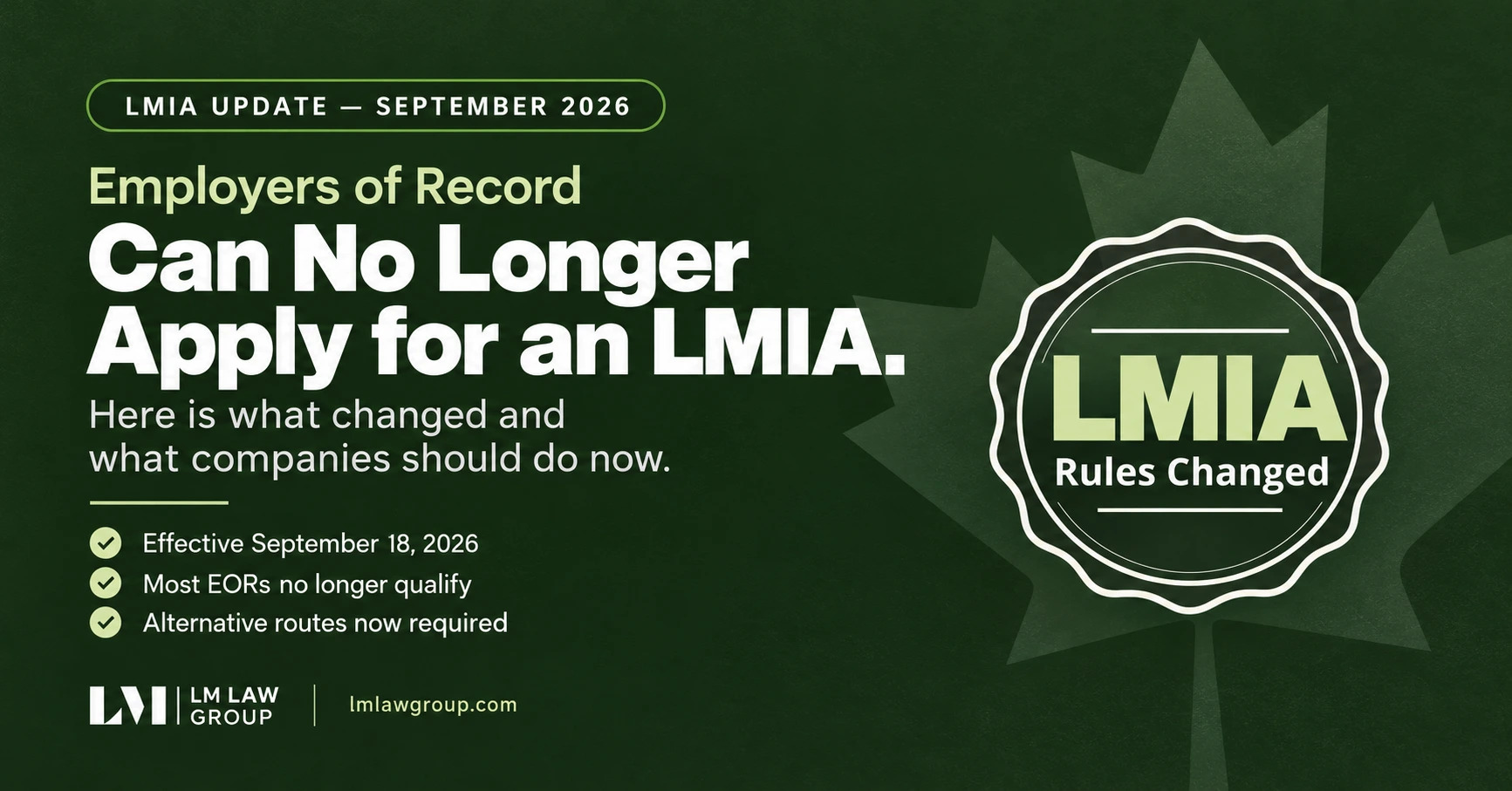
The federal government has clarified who qualifies as an “employer” for the purposes of a Labour Market Impact Assessment (LMIA). In practice, the update means most employers of record (EORs) can no longer apply as the employer on an LMIA. Here’s what changed, what it means for companies that rely on EORs, and what to do instead.
What Did Service Canada Announce About LMIA Employers?
On September 18th 2026, Service Canada updated its website to clarify who qualifies as an employer for the purposes of an LMIA. The effect of the clarification is to eliminate most employers of record from applying as the employer on an LMIA.
How Does Service Canada Now Decide Who the Employer Is?
Service Canada is no longer looking only at the name listed as the employer on the application. It is now examining the circumstances surrounding the employment relationship itself, including:
- Who controls the foreign worker’s job duties
- Who is ultimately responsible for paying the foreign worker
- Who manages the worker on a day-to-day basis
- Who is responsible for hiring or firing the individual
- Where the worker’s supervisor is located
These criteria focus on the actual work the employee does, not simply on who appears as the employer on the LMIA application.
What Does This Mean for Companies That Use an Employer of Record?
Consider a company based in the United States or elsewhere that places an employee in Canada by using an employer of record to run payroll and to obtain a work permit for that worker. That arrangement could become a significant problem going forward, because employers of record who do not fit the definition of employer as stated above will no longer be able to apply for LMIAs for these workers.
What Can Companies Do Instead to Transfer a Worker to Canada?
Companies in this position need to look at alternative routes to a work permit in Canada. This can be a multi-step process, and it involves two sides of the picture:
- The company. Depending on the situation, the company may need to register in Canada, set up a subsidiary, or open a branch office in Canada.
- The foreign worker. The worker’s own options should be reviewed to see what work permit routes may be available to them, such as through the Intra-company Transferee category, a free trade agreement or programs like the Francophone Mobility Program.
Because of this, it is now more important than ever to build a holistic plan for the foreign worker — one that looks at how they are eligible and what can be done to support them in obtaining a work permit in Canada.
Why Should Companies Plan Ahead?
Setting up a business or branch office in Canada can take time — even steps such as registering the office. If your long-term goal is to transfer workers to Canada, speak with an immigration lawyer well before the date the worker needs to be transferred. Planning ahead may determine whether the worker can actually be transferred on the day you need them here.
Frequently Asked Questions
Did Service Canada change who can apply for an LMIA as an employer?
Yes. On September 18, Service Canada updated its website to clarify who qualifies as an employer for the purposes of an LMIA. The clarification eliminates most employers of record from applying as the employer on an LMIA.
Can an employer of record apply for an LMIA?
In most cases, no. Employers of record are no longer recognized as employers that can apply for LMIAs for the workers they place in Canada.
What does Service Canada look at to determine who the employer is?
Service Canada looks beyond the name listed on the application and considers who controls the worker’s job duties, who is ultimately responsible for paying the worker, who manages the worker day to day, who is responsible for hiring or firing, and where the worker’s supervisor is located.
What can a company do if it needs to transfer a worker to Canada?
The company should look at alternative routes to a work permit. This may include registering in Canada, setting up a subsidiary, or opening a branch office, along with reviewing the worker’s own work permit options, such as a free trade agreement or the Francophone Mobility Program.
How early should a company start planning a transfer to Canada?
Well ahead of the date the worker needs to be transferred. Establishing an office in Canada can take time, so early planning with an immigration lawyer can determine whether the transfer can happen on schedule.
If your company needs to transfer a worker to Canada and has relied on an employer of record, LM Law Group can help you plan an alternative route.
Watch the full discussion: https://youtu.be/9mVR5JsU6IA